
Crop Tree Pruning
Source: PEI Ecosystem-Based Forest Management Standards Manual (October 2025), pp. 13–15
What it is
Crop tree pruning removes live or dead branches from selected crop trees so they grow valuable, knot-free wood.
Eligibility
The treatment is for crop trees selected to develop a clear bole in future.
Eligible species
| Group | Species |
|---|---|
| Native | Sugar maple, yellow birch, red oak, white ash, red spruce, white spruce, black spruce, eastern hemlock, white pine, red pine, eastern larch |
| With Department pre-approval | Red maple, largetooth aspen |
| Non-native | Norway spruce, Japanese larch |
Crop tree tests
| Softwood | Hardwood | |
|---|---|---|
| Crown class | Dominant or co-dominant | Dominant, co-dominant or intermediate |
| Form and health | Straight; free of insects, disease and damage | Straight; free of insects, disease and damage |
| Live crown | At least 50% | At least 30% |
| Other | — | No signs of epicormic branching |
The stand must be healthy and vigorous enough to keep growing for at least 20 years.
Standards and assessment
- Tools: handsaw and/or pruning saw; pruning shears only for branches under 1 cm.
- Height: the first pruning lifts the clear stem to 2.5 m, capped at 50%. The manual’s phrase “to a maximum of 50 % of the crop trees” is usually read as 50% of each tree’s height, consistent with blister rust pruning. Confirm with your technician if in doubt.
- Extraction trails: if pruning happens before a thinning, don’t prune trees standing in future extraction trails.
- Timing: prune only while trees are dormant.
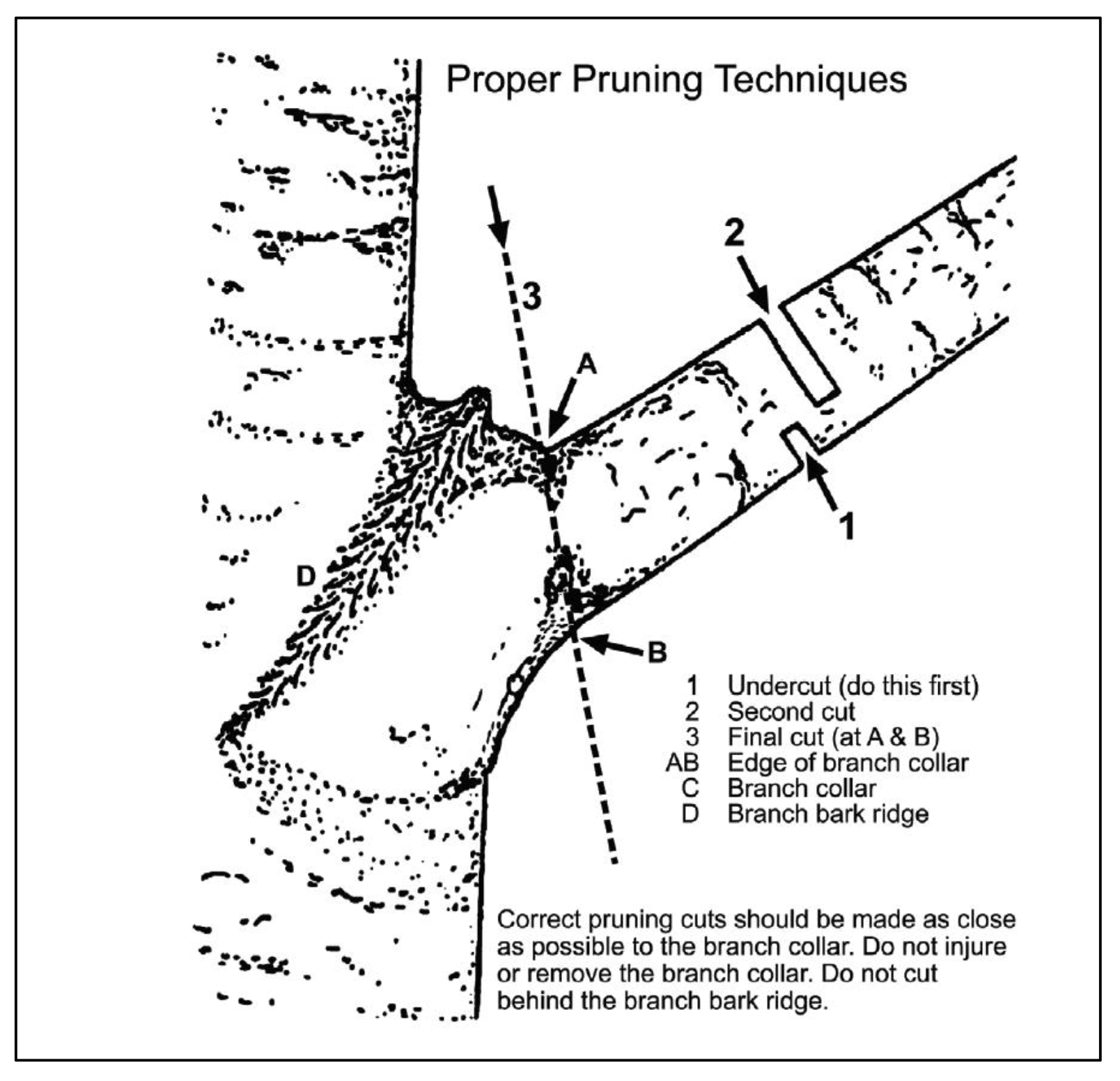
- Cut placement: just outside the branch collar, leaving a stub no longer than 1 cm.
- Damage limit: if more than 5% of the treated stems are damaged, the area is not eligible for incentive payment. Damage means bark damage that exposes more than 1 cm² of sapwood.
Based on the PEI Ecosystem-Based Forest Management Standards Manual (October 2025), pp. 13–15. Where this guide and the manual differ, the manual governs.